


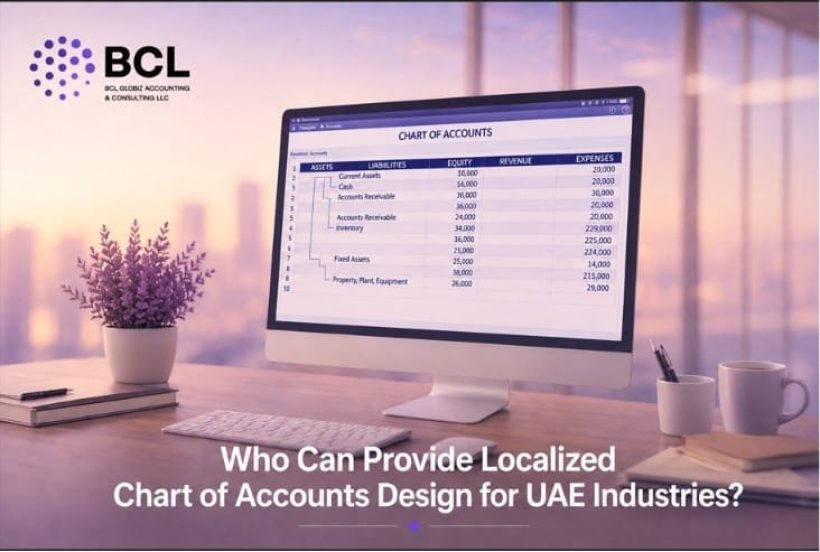
A localised chart of accounts is a structured general ledger designed around the specific tax, legal, and reporting requirements of a given country. For UAE businesses, that means building it to support VAT classification, corporate tax tracking, and FTA record-keeping obligations from day one. Getting this foundation right means your everyday bookkeeping can produce cleaner data for VAT returns and corporate tax filings, rather than requiring manual reclassification at every reporting deadline.
Key Takeaways
- A localised chart of accounts adapts standard ledger categories to UAE VAT and corporate tax requirements, separating taxable, zero-rated, exempt, and out-of-scope transactions at the account level.
- The UAE standard VAT rate is 5%, and corporate tax is generally 9% on taxable income exceeding AED 375,000. Both regimes depend on accurate transaction classification in the ledger.
- A UAE-compliant chart of accounts should have dedicated accounts for output VAT, recoverable input VAT, blocked input VAT, reverse charge entries, non-deductible expenses, and related-party balances.
- Common mistakes, such as using a single combined VAT account or mixing taxable and exempt revenue, make filing harder and can increase audit risk.
- BCL Globiz sets up charts of accounts and invoice templates as part of its accounting, VAT, and corporate tax packages, with services starting from AED 500 per month.
What Is a Localised Chart of Accounts?
A chart of accounts (COA) is the indexed list of general ledger accounts a business uses to record every financial transaction, typically grouped into assets, liabilities, equity, revenue, and expenses. A localised chart of accounts takes that standard structure and adapts it to the compliance requirements of a specific jurisdiction, which in the UAE’s case means primarily VAT and corporate tax.
The practical difference from a generic COA is one of purpose. A generic template is usually built for internal bookkeeping only. A localised COA is designed so that statutory reporting, tax reconciliation, and audit trails emerge naturally from the same ledger entries finance teams are already making. This means fewer manual adjustments and a more efficient filing process.
For UAE businesses, this distinction matters because VAT and corporate tax compliance require businesses to maintain accounting records that can be verified and reconciled. A COA built without those requirements in mind creates gaps between the books and the tax returns, gaps that cost time and effort when a review arises.
Why UAE Businesses Need a Localised Chart of Accounts?
UAE businesses need localised accounting records because VAT and corporate tax reporting depend on accurate transaction classification at the point of entry, not just aggregate totals at period end. A chart of accounts that separates taxable, zero-rated, exempt, reverse-charge, and blocked-input transactions allows VAT returns to be prepared directly from the ledger with minimal manual intervention.
For corporate tax, the need is equally direct. Taxable income is calculated by starting with accounting profit and then making specific adjustments, including non-deductible expenses, related-party transactions, and any applicable reliefs. If those items are not already identified and tracked at the account level, producing a defensible corporate tax computation becomes an exercise in reconstruction rather than a straightforward reporting task.
Businesses in management consultancy, IT, ecommerce, trading, and high sea sales each face a slightly different mix of VAT treatments and revenue streams, which makes a tailored COA especially valuable compared with a generic imported template.
Key UAE Compliance Requirements to Consider
UAE businesses are required to maintain proper accounting records for VAT and corporate tax compliance. For VAT purposes, records must generally be retained for a minimum of five years. For corporate tax purposes, businesses are generally required to retain records for seven years from the end of the relevant tax period.
These retention obligations mean that the accounting system, and the chart of accounts that underpins it, must be capable of producing verifiable, auditable records, not merely summary reports. The FTA has authority to request supporting documentation going back several years, so a well-designed COA that supports clean audit trails is a core compliance requirement.
Core Components of a UAE Chart of Accounts
A practical UAE COA uses the five standard account categories but adds sub-accounts wherever VAT treatment or corporate tax classification creates a reporting need. The standard groupings and a common numbering convention look like this:
| Range | Category |
| 1000s | Assets |
| 2000s | Liabilities |
| 3000s | Equity |
| 4000s | Revenue |
| 5000s | Expenses |
Within those ranges, the UAE-specific additions are primarily concentrated in assets (input VAT receivable), liabilities (output VAT payable, corporate tax payable), revenue (split by VAT treatment), and expenses (deductible versus non-deductible, related-party charges). The exact numbering can be adapted to the accounting software in use, but the underlying logic should remain consistent.
How VAT Affects Chart of Accounts Setup?
The UAE standard VAT rate is 5%, and businesses registered for VAT need to account separately for each type of supply and each type of input they incur. A VAT-ready chart of accounts typically includes dedicated accounts for:
- Output VAT: VAT charged to customers on standard-rated supplies
- Input VAT recoverable: VAT paid on business purchases that can be reclaimed
- Input VAT blocked or non-recoverable: VAT on entertainment, employee benefits, and other restricted categories
- Zero-rated sales: revenue on which VAT applies at 0%
- Exempt sales: revenue on which no VAT is charged under exempt treatment
- Reverse charge purchases and imports: where the buyer accounts for VAT rather than the supplier
- VAT adjustments and penalties: any corrections or FTA-imposed charges
This structure allows VAT return preparation to proceed directly from the trial balance rather than requiring manual reclassification. It also makes the reconciliation between VAT returns and financial statements more straightforward, which is important during FTA audits or voluntary disclosures.
Mixing taxable and exempt revenue in the same account, or using a single combined VAT account for all movements, is one of the most common mistakes UAE businesses make, and it is also one of the most avoidable with a properly designed COA from the outset.
How Corporate Tax Affects Chart of Accounts Setup?
UAE corporate tax is generally 9% on taxable income exceeding AED 375,000. For businesses below that threshold, the rate is 0%, but record-keeping and filing obligations may still apply. A corporate-tax-ready chart of accounts should make it straightforward to track:
- Revenue by business line: particularly relevant for businesses with multiple activities or revenue streams
- Deductible operating expenses: standard costs that reduce taxable income
- Non-deductible expenses: items that must be added back in the tax computation, such as fines, penalties, and certain entertainment costs
- Related-party balances and charges: loans, management fees, and service charges between connected persons
- Provisions and accruals: which may require different treatment across periods
- Transfer pricing documentation references: for businesses with significant related-party dealings
The corporate tax computation starts with accounting profit as reported in the financial statements. If the COA does not already isolate non-deductible items and related-party transactions, the finance team must identify and reclassify them manually every year, an error-prone process that also makes it harder to respond quickly if the FTA asks questions.
Industry-Specific Chart of Accounts Considerations
Different business types in the UAE face different account-level decisions.
Management Consultancy and IT Services
Management consultancy and IT services businesses typically earn standard-rated revenue but may also have cross-border contracts that are zero-rated for VAT. The COA should separate domestic and export service revenue, and where reverse charge applies on imported services, those should also have dedicated accounts.
Ecommerce Businesses
Ecommerce businesses may deal with multiple VAT treatments depending on the customer location, the nature of goods or services, and whether the sale crosses a customs boundary. Revenue accounts should be structured to reflect these distinctions from the point of sale.
Trading and High Sea Sales Businesses
Trading and high sea sales businesses often deal with imports, exports, and goods that transfer title while in transit, creating complex VAT and customs interactions. Inventory accounts, cost of goods sold, and VAT on imports should all be tracked at a level of detail that supports both VAT returns and corporate tax computations.
For businesses with related-party transactions, common in group structures and in family businesses operating across multiple entities, the chart of accounts should include explicit sub-accounts for intercompany balances, management charges, and related-party loans so that transfer pricing documentation can be prepared more efficiently.
Example Structure for a UAE Localised Chart of Accounts
The following structure is illustrative of a practical SME-level UAE COA. It is intentionally straightforward at the top level while providing the sub-account detail needed for VAT and corporate tax compliance.
1000-1999: Assets
- 1100 Cash and bank
- 1200 Trade receivables
- 1300 Prepayments and deposits
- 1400 VAT input tax receivable (recoverable)
- 1450 VAT input tax blocked (non-recoverable)
- 1500 Fixed assets
- 1600 Accumulated depreciation
2000-2999: Liabilities
- 2100 Trade payables
- 2200 Accrued expenses
- 2300 VAT output tax payable
- 2350 Reverse charge VAT liability
- 2400 Corporate tax payable
- 2500 Related-party payables
3000-3999: Equity
- 3100 Share capital
- 3200 Retained earnings
- 3300 Owner’s drawings
4000-4999: Revenue
- 4100 Standard-rated sales (5% VAT)
- 4200 Zero-rated sales
- 4300 Exempt income
- 4400 Out-of-scope income
- 4500 Other income
5000-5999: Expenses
- 5100 Salaries and wages
- 5200 Rent and occupancy
- 5300 Professional and legal fees
- 5350 Related-party management fees
- 5400 Non-deductible expenses
- 5500 Marketing and advertising
- 5600 Bank charges and finance costs
- 5700 Depreciation
- 5800 Corporate tax expense
This structure is consistent with the five-category framework and reflects the UAE-specific need to isolate VAT treatments, tax-sensitive expenses, and related-party activity at the account level.
Common Mistakes Businesses Make
Even businesses that use professional accounting software frequently make chart-of-accounts errors that create compliance risks. The most common in the UAE context are:
- Using a single VAT account for all movements. Combining output VAT, recoverable input VAT, and blocked input VAT in one account makes it difficult to reconcile VAT returns to the ledger without manual workings. The FTA may request this reconciliation during a review.
- Mixing taxable and exempt revenue. When standard-rated and exempt supplies are recorded in the same revenue account, partial exemption calculations for input VAT recovery become difficult and the VAT return cannot be prepared directly from the trial balance.
- Not separating non-deductible expenses. If entertainment costs, fines, or penalties are mixed into general expense accounts, identifying them for corporate tax add-back requires a full review of transactions rather than a simple account query.
- Ignoring related-party transactions. Intercompany balances, management charges, and related-party loans that are not tracked separately cannot be easily reconciled for transfer pricing purposes, increasing the risk of an unsupported position.
- Booking corporate tax only at year-end. Periodic corporate tax accrual entries are easier to track through a dedicated corporate tax payable account rather than appearing only as a year-end adjustment with limited visibility in monthly management accounts.
- Over-engineering the COA. Too many low-use accounts create maintenance burden without adding compliance value. The goal is enough granularity to support VAT and tax reporting, not a ledger so detailed that routine posting becomes error-prone.
How BCL Globiz Helps Set Up and Maintain a Localised Chart of Account?
BCL Globiz is a professional accounting, tax, and business advisory firm based in Dubai and the UAE. The firm offers end-to-end solutions covering accounting, bookkeeping, auditing, corporate tax, VAT, transfer pricing, company incorporation, free zone setup, and tax-saving advisory.
As part of its service delivery, BCL sets up charts of accounts and invoice templates for clients and provides ongoing support for VAT, corporate tax, transfer pricing, and compliance. Each client is assigned a dedicated Manager and Account Executive, and the firm’s all-inclusive packages, starting from AED 500 per month, typically cover accounting, VAT, and corporate tax together.
BCL’s execution is SOP-driven, with fast escalations handled by Managers and Partners, dedicated WhatsApp communication for day-to-day queries, and flexibility on pricing where the client’s needs warrant it. For businesses that are new to the UAE or that have inherited an accounting setup that was not built with local tax requirements in mind, BCL provides the COA design, bookkeeping, and compliance support needed to help align records with local reporting and tax requirements.
Need help setting up a UAE-compliant chart of accounts? Contact BCL Globiz for accounting, VAT, and corporate tax support.
Frequently Asked Questions
What is a localised chart of accounts?
A localised chart of accounts is a general ledger structure adapted to the tax, legal, and reporting requirements of a specific country. In the UAE, it means designing account categories and sub-accounts to support VAT classification, corporate tax computation, and FTA record-keeping obligations, rather than using a generic global template.
Is a chart of accounts mandatory in the UAE?
While there is no single law that mandates a specific chart of accounts format, UAE businesses are required to maintain proper accounting records under both VAT and corporate tax legislation. A well-structured COA is the foundation for meeting those obligations and for producing records that can be reviewed by the FTA.
How should VAT be recorded in a UAE chart of accounts?
VAT should be recorded using separate accounts for output VAT payable, recoverable input VAT, non-recoverable (blocked) input VAT, and reverse charge VAT. Revenue accounts should distinguish standard-rated, zero-rated, exempt, and out-of-scope supplies. This separation allows VAT returns to be prepared directly from the ledger.
Does corporate tax require changes to the chart of accounts?
Yes. A UAE corporate-tax-ready COA should have dedicated accounts for non-deductible expenses, related-party balances and charges, corporate tax payable, and tax-period accruals. Without these, preparing an accurate corporate tax computation requires manual transaction-level review, which increases time and error risk.
Can the same chart of accounts be used for every UAE business?
No. While the five-category structure (assets, liabilities, equity, revenue, expenses) is universal, the sub-accounts needed vary significantly by industry. An ecommerce business, a management consultancy, and a trading company each have different VAT treatment profiles, revenue types, and expense structures that require different account-level design.
How often should a chart of accounts be reviewed?
A chart of accounts should be reviewed at least annually, or whenever the business adds a new activity, enters a new market, changes its VAT registration status, or comes under a new tax obligation. It should also be reviewed when migrating to a new accounting system to ensure the localised structure is correctly replicated.
Can BCL help set up a chart of accounts for a UAE company?
Yes. BCL Globiz sets up charts of accounts and invoice templates as part of its accounting, VAT, and corporate tax packages. The firm works with businesses across management consultancy, IT, ecommerce, trading, and other sectors, with all-inclusive packages starting from AED 500 per month and a dedicated Manager and Account Executive assigned to each client.