


Key Takeaways
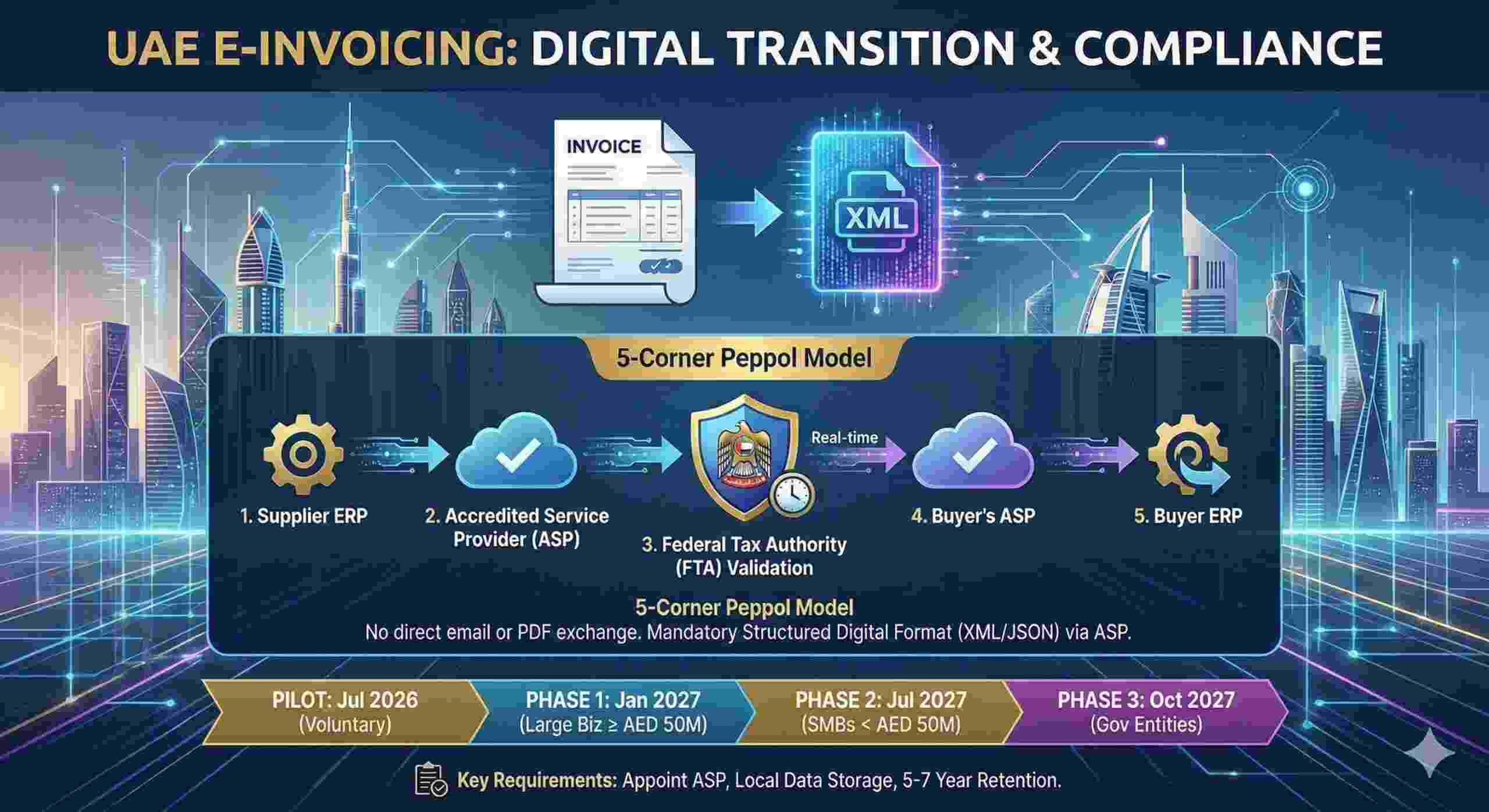
- E-invoicing becomes mandatory in the UAE starting July 2026 for pilot programs, with full implementation by January 2027 for large businesses (AED 50M+ revenue) and July 2027 for smaller businesses.
- All businesses must use Accredited Service Providers (ASPs) to validate, transmit, and report e-invoice data to the Federal Tax Authority.
- E-invoices must follow structured formats (XML/PDF with embedded data) and include mandatory fields like VAT numbers, unique invoice IDs, and tax breakdowns.
Why Choose BCL Globiz?
We’re the only UAE firm combining SOP-driven speed, accuracy, and transparent pricing—no surprises, no upselling. Dedicated WhatsApp support and a trusted partner for CAs & B2B firms globally.
The UAE has been advancing its digital transformation journey, especially in relation to legal and taxation regulations. VAT was introduced in 2018 and Corporate tax in 2023. The next major step in streamlining the tax and regulatory compliance is “e-invoicing.” The majority of the countries are implementing an e-invoicing system to regulate the method of invoice generation, and the UAE has also followed the same footsteps.
BCL Globiz specializes in supporting international SMEs, consultants, and B2B partners relocating to the UAE for tax-efficient, compliant business setup.
In this blog, we try to learn and decode e-invoicing, equipping our readers with the knowledge to be compliant well before its implementation.
Legal Framework and Regulatory Background for E-Invoicing in the UAE
The UAE’s e-invoicing mandate is established through a comprehensive legal framework designed to enhance tax compliance and digital transformation. The regulatory foundation includes:
- Federal Law No. 1 of 2006 – Provides the constitutional basis for tax administration and electronic documentation
- Ministerial Decision No. 243 of 2025 – Establishes technical standards and ASP accreditation requirements
- Ministerial Decision No. 244 of 2025 – Defines implementation timeline and compliance obligations
- Cabinet Decision No. 106 of 2025 – Outlines penalties and enforcement mechanisms
The UAE Ministry of Finance (MoF) serves as the primary regulatory authority, while the Federal Tax Authority (FTA) handles compliance monitoring and enforcement. This dual-authority structure ensures both policy development and operational oversight.
What Is E-Invoicing and What Is Not Considered an E-Invoice?
The Ministry of Finance defines it as a structured form of invoice data that is issued and exchanged electronically between a supplier and a buyer and reported electronically to the UAE Federal Tax Authority. It is important to note that unstructured invoice formats such as PDF, Word documents, images, scanned copies, and emails are not e-invoices.
Businesses already following VAT rules should also understand how to raise a VAT-compliant invoice in the UAE, as e-invoicing will further standardize invoice formats and reporting requirements.
E-Invoicing Implementation Timeline and Key Dates
Articles 3, 4 and 5 of the Ministerial Decision No. 244 of 2025 on the Implementation of the Electronic Invoicing System show-
- Pilot program: The ministry shall notify a person to include in the Taxpayer Working Group. Such a person shall be included in such a group and shall comply with all technical requirements established. This pilot program shall commence on 1st July 2026.
- Voluntary implementation: If any person on a voluntary basis implements from 1st July 2026 and complies with all technical requirements.
- Large business: Any person whose revenue is equal to or more than AED 50,000,000 shall appoint an Accredited Service Provider (ASP) by 31st July 2026 and implement an e-invoicing system by 1st January 2027.
- Smaller business: Any person whose revenue is less than AED 50,000,000 shall appoint an Accredited Service Provider (ASP) by 31st March 2027 and implement an e-invoicing system by 1st July 2027.
- A government entity shall appoint an accredited service provider by 31st March 2027 and implement e-invoicing from 1st October 2027.
Scope of E-Invoicing: Who Must Comply and Who Is Exempt?
Who Must Comply:
- B2B Transactions: All business-to-business invoice exchanges
- B2G Transactions: Business-to-government invoice submissions
- Large Enterprises: Companies with revenue ≥ AED 50 million
- SMEs: Companies with revenue < AED 50 million (phased implementation)
- Government Entities: All UAE federal and local government bodies
E-Invoicing Exemptions and Out-of-Scope Transactions
Who is Exempt:
- Business transactions conducted by government entities in their sovereign capacity.
- International passenger transportation services provided by an airline via an aircraft, where an electronic ticket is issued to the passengers.
- Any ancillary services related to the previous point where an electronic miscellaneous document is issued.
- International transportation services in respect of goods, provided by an airline, where an airway bill is issued for such services for a period of 24 months from the date of e-invoicing becoming effective.
- Financial services that are exempt from VAT or subject to VAT at the zero rate, in accordance with Article 42 of the VAT Executive Regulation.
- Currently, the business-to-consumer transactions are not covered in the e-invoicing system. Any companies engaged in B2C transactions need not comply with e-invoicing for such transactions until determined by a decision issued by the minister.
E-Invoicing Process Flow: Step-by-Step Overview
The UAE e-invoicing process follows a structured workflow through the Peppol network:
- Invoice Creation: Supplier creates structured e-invoice using compliant software
- ASP Validation: Supplier’s ASP validates invoice format and mandatory fields
- Digital Signing: Invoice receives cryptographic signature for authenticity
- Network Transmission: ASP transmits invoice through Peppol network to buyer’s ASP
- Buyer Receipt: Buyer receives and processes invoice through their ASP
- FTA Reporting: Tax-relevant data automatically reported to Federal Tax Authority
- Archival: Invoice stored in compliant format for statutory retention period
Who is an Accredited Service Provider (ASP)?
An ASP is a service provider entity that has received official accreditation by the UAE Ministry of Finance (MoF) to participate in the e-invoicing ecosystem. Basically, the business must use ASP to validate, transmit, exchange, and report the e-invoice data.
An Accredited Service Provider (ASP) is not just a vendor—it is the technical gateway between your business and the UAE e-invoicing network.
Role and Responsibilities of Accredited Service Providers (ASPs)
- Validates the e-invoice submitted by the supplier to check the mandated format and data requirements.
- Converts the invoice into a structured digital format via the OpenPeppol/Peppol-based standard.
- Transmits e-invoice to the buyer’s ASP.
- Reports tax-relevant data from e-invoice to the FTA.
- Ensures ongoing compliance with security, technical, and regulatory standards.
Mandatory E-Invoice Fields and Technical Requirements
All UAE e-invoices must include the following mandatory fields and meet technical specifications:
| Field Category | Required Fields | Format |
| Supplier Details | Name, Address, VAT Number, Trade License | Structured Text |
| Buyer Details | Name, Address, VAT Number (if applicable) | Structured Text |
| Invoice Identifiers | Unique Invoice ID, Issue Date, Due Date | Alphanumeric/Date |
| Line Items | Description, Quantity, Unit Price, Total | Decimal/Text |
| Tax Information | VAT Rate, VAT Amount, Total Tax | Decimal |
Technical Format Requirements:
- Primary Format: XML based on Peppol BIS 3.0 standard
- Alternative Format: PDF/A-3 with embedded XML data
- Character Encoding: UTF-8
- Digital Signature: XMLDSig or equivalent
What is expected of UAE e-invoicing?
- Standardization of invoice formats such as XML / PDF with embedded structured data
- Unique invoice identification numbers
- Real-time reporting to the tax system
- Authentication and validation through a secured platform
- Storage of invoices in electronic formats for statutory purposes
Penalties and Fines for Non-Compliance with E-Invoicing
The UAE has established clear penalties for e-invoicing non-compliance under Cabinet Decision No. 106 of 2025:
- Late Implementation: AED 10,000 for each month of delay beyond mandatory dates
- Incorrect E-Invoice Format: AED 1,000 per non-compliant invoice (up to AED 50,000 per month)
- Missing Mandatory Fields: AED 500 per incomplete invoice
- Failure to Use ASP: AED 25,000 initial penalty + AED 5,000 per month until compliance
- Data Retention Violations: AED 15,000 for inadequate archival systems
Repeat Offenses: Penalties may be doubled for businesses with multiple violations within a 12-month period.
How should the businesses prepare for e-invoicing now in the UAE?
- Assess the current invoicing flow
- Upgrade the accounting/ERP systems
- Invest in reliable e-invoicing tools
- Train finance and compliance teams
- Strengthen document retention controls
E-Invoicing Preparation Checklist
- Conduct gap analysis of current invoicing processes
- Select and contract with an accredited ASP
- Upgrade accounting software to support structured data formats
- Train finance teams on new e-invoicing workflows
- Test e-invoice generation and transmission
- Establish compliant archival and retention procedures
- Update internal controls and approval workflows
To comply effectively, businesses should evaluate and upgrade their systems using FTA-approved accounting software solutions in Dubai that can integrate with the UAE e-invoicing framework.
Benefits of E-Invoicing for UAE Businesses
- Operational Efficiency: Automated invoice processing reduces manual work by up to 80%
- Cost Reduction: Eliminate paper, printing, and postal costs (average savings: AED 15-25 per invoice)
- Faster Payments: Real-time delivery accelerates payment cycles by 30-50%
- Enhanced Compliance: Automated validation reduces errors and ensures FTA compliance
- Improved Cash Flow: Faster processing and payment cycles improve working capital
- Environmental Impact: Significant reduction in paper usage supports sustainability goals
- Audit Readiness: Structured data and automated archival simplify audit processes
Archiving and Data Retention Requirements for E-Invoices
UAE businesses must maintain e-invoices according to specific retention requirements:
- Retention Period: Minimum 5 years from invoice date
- Storage Format: Original structured format (XML) plus human-readable version
- Accessibility: Must be retrievable within 24 hours of FTA request
- Data Integrity: Digital signatures and timestamps must remain valid
- Backup Requirements: Secure, geographically distributed backup systems
E-invoicing marks a big leap in the digital transformation. Businesses that adopt early will stay compliant and gain a competitive advantage through automation and improved financial control.
As Dubai’s leading compliance-focused firm, BCL Globiz proactively secures all necessary registrations, ensures timely filings, and keeps you ahead of regulatory changes. We offer one-roof solutions to businesses on accounting, VAT, corporate tax, transfer pricing, and payroll, enabling the business to harvest the maximum benefit of outsourcing critical functions.
Our team of experts helps and guides you to obtain all necessary registrations and certificates, file returns, and get the latest updates about e-invoicing to stay compliant and to stay ahead of the competition.
Frequently Asked Questions about E-Invoicing in the UAE
Is e-invoicing mandatory in the UAE?
Yes, e-invoicing is mandatory for all B2B and B2G transactions in the UAE. Implementation begins with pilot programs in July 2026, with full mandatory compliance by January 2027 for large businesses and July 2027 for smaller businesses.
Who is required to issue e-invoices in the UAE?
All UAE businesses engaged in B2B or B2G transactions must issue e-invoices. This includes companies of all sizes, government entities, and organizations conducting commercial activities. B2C transactions are currently exempt.
What are the penalties for non-compliance with e-invoicing regulations?
Penalties range from AED 500 for missing mandatory fields to AED 25,000 for failure to use an ASP. Late implementation incurs AED 10,000 per month of delay. Repeat offenses may result in doubled penalties.
What formats are accepted for e-invoices in the UAE?
UAE e-invoices must be in structured formats: primarily XML based on Peppol BIS 3.0 standard, or PDF/A-3 with embedded XML data. Simple PDF, Word documents, or scanned copies are not acceptable.
How long must e-invoices be archived in the UAE?
E-invoices must be retained for a minimum of 5 years from the invoice date in their original structured format, with the ability to retrieve them within 24 hours of an FTA request.
Ready to Ensure E-Invoicing Compliance?
Contact BCL Globiz for a free consultation with Dubai’s most trusted, all-in-one accounting and tax advisory firm. We specialize in SMEs, consultants, IT, ecommerce, and trading businesses.


